
The Invisible Burden of Climate Change on Women: Between Survival and Resilience
Rural women are not only actors of local development, they are its true “architects.” In Cameroon’s rural areas, they are on the frontlines of climate change impacts as well as large-scale development or resource exploitation projects, whether mining or forestry. Their social role—essential yet often undervalued—becomes a crushing burden when natural resources grow scarce due to climate change and so-called development projects.
💧 A Growing Physical and Emotional Burden
The scarcity of drinking water, arable land, non-timber forest products (NTFPs), and firewood forces women to travel increasingly long distances to meet their households’ basic needs. These journeys, often in isolated areas, expose them to various dangers (snakes, insects, etc.), and in some localities, to heightened risks of sexual violence. According to WoMin, women are particularly vulnerable on resource collection routes due to isolation and lack of protection in exploitation zones.
In Cameroon, women represent 80% of the family agricultural workforce. Yet climate disruptions have led to declining yields, growing food insecurity, and unstable incomes. This intensifies their mental and physical load while reducing their economic autonomy.
🌱 Resilience et local strategies
Women in the communities of Oboul 1 (Abong Bang, East Cameroon) and Akom 2 (South Cameroon) now face increasing difficulties in accessing NTFPs because of logging activities that destroy the very trees they depend on. At the same time, crop yields decline year after year due to soil fertility loss.
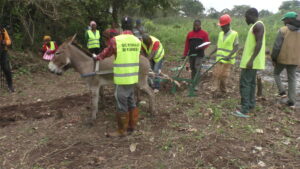
To cope with these constraints, women turn to agroecological practices or participatory mapping to secure the spaces they use and to inform land-use planning processes. For example, women in Akom 2 submitted maps to the Ministry of Forests and Wildlife showing the areas they rely on, with the aim of ensuring these spaces are considered in forest exploitation permit allocations.
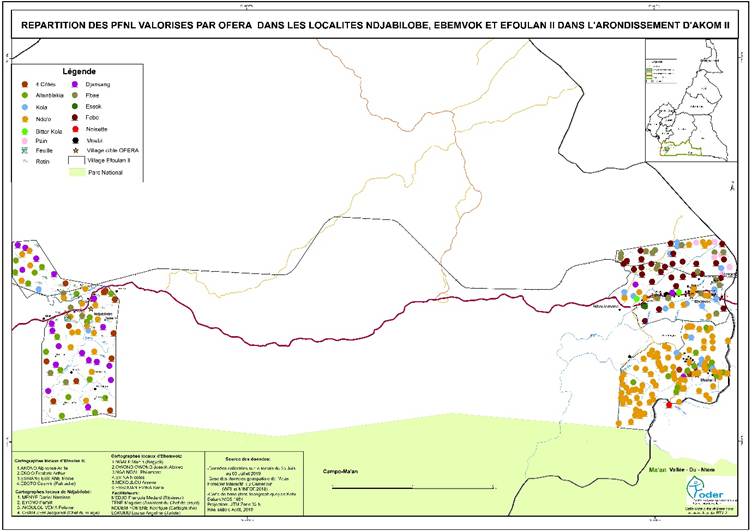
Map representing places where women collect non timber forest product in Akom2
🦟 Diseases like Malaria: A Silent Threat
Climate change creates increasingly favorable conditions for the spread of disease vectors, especially in humid and poorly drained areas, including the northern regions. Waterborne diseases are also on the rise.
Over the past decade, malaria prevalence among women in Cameroon has shown worrying trends. The National Institute of Statistics (INS) reported an increase in parasitic prevalence among pregnant women: 49% in the Centre region, 46% in the South, and 41% in the East. In 2023, prevalence was estimated at 21%, or about 203 cases per 1,000 women. Malaria significantly increases the risk of anemia, miscarriage, and maternal mortality.
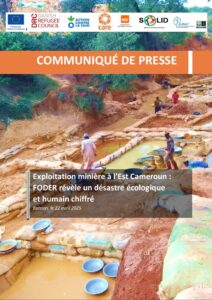
Women in artisanal mining sites are even more exposed. During the rainy season, mining pits turn into reservoirs of stagnant, unsafe water, ideal breeding grounds for mosquitoes and other pathogens. Lacking adequate resources, these women cannot effectively manage the risks linked to mining activities.
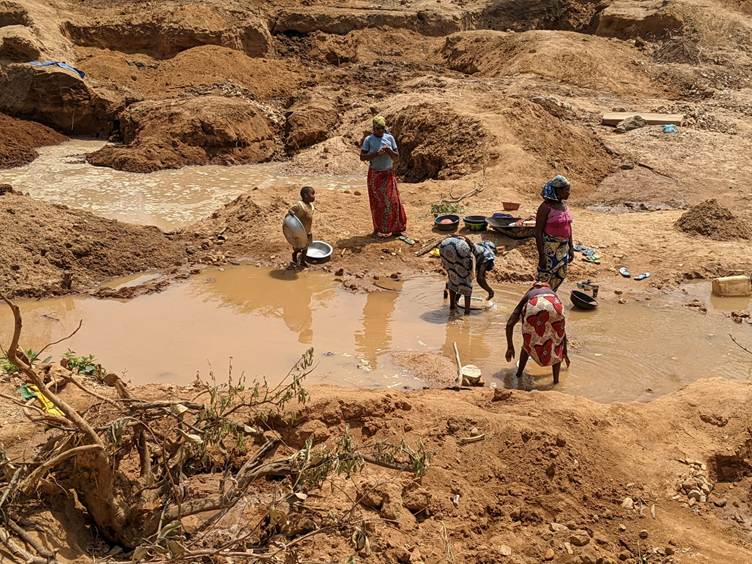
Mining Women of Oum Yari (Banyo, Adamaoua)
It is also important to note that women, often responsible for caring for the sick, suffer a double burden: they look after ill relatives while being highly exposed themselves. This situation affects their physical and mental health, their psychological well-being, and their ability to fulfill social and family roles.
Local solutions exist, but remain Underused
In response to these challenges, women adopt increasingly resilient behaviors. Adaptation practices have been explored by the association Forêts et Développement Rural (FODER) through community support initiatives. These solutions, which deserve to be scaled up, can help ease women’s burdens:
- Agroecology: improves soil fertility, reduces dependence on chemical inputs, promotes local seeds, values traditional knowledge, and secures yields.
- Women’s organizations and savings groups: such as Village Savings and Loan Associations (VSLAs), which strengthen solidarity, mutual support, and shared learning.
- Improved stoves and ecological charcoal: reduce firewood consumption, lower harmful emissions, and ease cooking.
- Community awareness campaigns: build local capacity to prevent disease, adopt resilient behaviors, and protect women in their social roles.
- Restoration of degraded land: fosters biodiversity regeneration, curbs erosion, and improves long-term access to resources.
- Improving women’s access to basic needs (land, water, health, energy) is essential. These needs are interconnected: for example, women’s access to land directly contributes to community food security.

It is therefore imperative that climate and development policies integrate a gender-sensitive and community-based approach.
Investing in women means investing in the resilience of territories. It means building a future where development is not carried out at the expense of the most vulnerable, but with them, for them, and thanks to them.
The need for inclusive structural action
Isolated, localized resilience efforts cannot be sustainable without inclusive, structural strategies led by public authorities and development actors.
Existing solutions require adapted technical, logistical, and material resources: agricultural tools, training, health infrastructure, and above all, political will to recognize women’s central role in climate resilience.
Women are not passive victims: they are agents of change, guardians of biodiversity, and silent innovators. But without protection and resources, their potential remains underutilized, their voices unheard, and their contributions undervalued.
Bibliography
https://ins-cameroun.cm/wp-content/uploads/2025/07/01_FaibleReduction_FRE.pdf
https://ins-cameroun.cm/wp-content/uploads/2025/07/01_FaibleReduction_FRE.pdf
#JournéeInternationaleFemmesRurales #FODER #RealGRNS #ACJC #ClimateJustice #WoMin #REPAC #KilimoEkolojia #UNWomen #Gender #ClimateChange
By Christiane ZEBAZE